
- LASIK
- May 2026
You’ve thought about LASIK for years. Maybe a friend had it done and has been raving about the results, or you’re tired of fogged-up glasses and dry contact lenses by 3 p.m. Now you’re ready to take the next step, and that starts with a consultation.
A LASIK consultation is where you find out whether laser vision correction is a good fit for your eyes, lifestyle, and goals. At Campus Eye Group, this visit is designed to give you clear answers and a realistic picture of what LASIK can do for you.
Here’s what to expect from start to finish, what your eye doctor will check, and the conversations worth having before you make a decision about LASIK.
What are the Benefits of LASIK?

LASIK is the most popular refractive procedure in the country, and it’s no mystery why. The surgery itself takes roughly five minutes per eye and is painless during and after, with most patients reporting little more than mild scratchiness for a few hours afterward.
Visual improvement happens quickly. Many patients notice significant improvement the same day, with vision continuing to sharpen over the following week.
The bigger picture is convenience. LASIK can reduce or eliminate the daily routine of glasses and contacts: no more fogged-up lenses in winter, no more contact lens cases on the bathroom counter, no more reaching for them first thing in the morning.
For active patients who swim, run, or work in dusty environments, that freedom is the real draw. And because the results don’t fade, LASIK is a lifelong investment in clear vision.
Why Your LASIK Consultation Matters

A LASIK consultation is not a sales pitch; it is where the real decision is made. Because LASIK is permanent, the consultation’s primary goal is to confirm that laser vision correction is the right choice for you before proceeding.
Think of it as a two-way conversation. Your ophthalmologist gathers detailed information about your eyes, and you gather detailed information about LASIK.
By the end, both sides should have enough facts to decide whether to move forward, hold off, or consider a different option entirely. A good consultation will tell you when LASIK is a strong fit and when it isn’t.
What Happens During the Eye Exam Portion?
The exam portion of a LASIK consultation is more detailed than a standard eye check-up. Your eye doctor needs precise measurements before recommending a procedure, which means undergoing several important tests:
Vision and Refractive Error Testing
First, your eye doctor confirms your current prescription and assesses its stability. Prescriptions can change in early adulthood, during pregnancy, and around age 40. A stable prescription for at least one year indicates readiness for refractive surgery. Your refractive error must also fall within the FDA-approved range for LASIK.
Corneal Mapping and Thickness
Next, corneal topography creates a detailed map of your cornea’s surface. Patients selecting advanced topography-guided treatment, such as Contoura, have this mapping integrated into their procedure. Your eye doctor also measures corneal thickness, as LASIK reshapes the cornea by removing tissue. Thin or irregular corneas may affect which procedures are recommended.
Overall Eye Health Check
Finally, the team checks for conditions that could impact your surgery or recovery, such as dry eye, keratoconus, cataracts, glaucoma, or corneal scars. These findings may not always disqualify you, but they can influence your options.
Determining Whether You’re a LASIK Candidate
Determining candidacy is central to the LASIK consultation. While most patients are suitable candidates, the consultation confirms this before scheduling any procedure.
Basic requirements include being at least 18 years old (ideally over 21, when vision stabilizes), having a stable prescription, healthy eyes, adequate corneal thickness, and well-managed general health.
Some conditions can rule LASIK out or push it down the list. Severe dry eye, keratoconus, advanced glaucoma, vision-affecting cataracts, uncontrolled diabetes, and certain autoimmune diseases all fall into this group. Medications you take regularly can also factor in, so come prepared to share a complete list.
Talking About Lifestyle, Goals, and Expectations
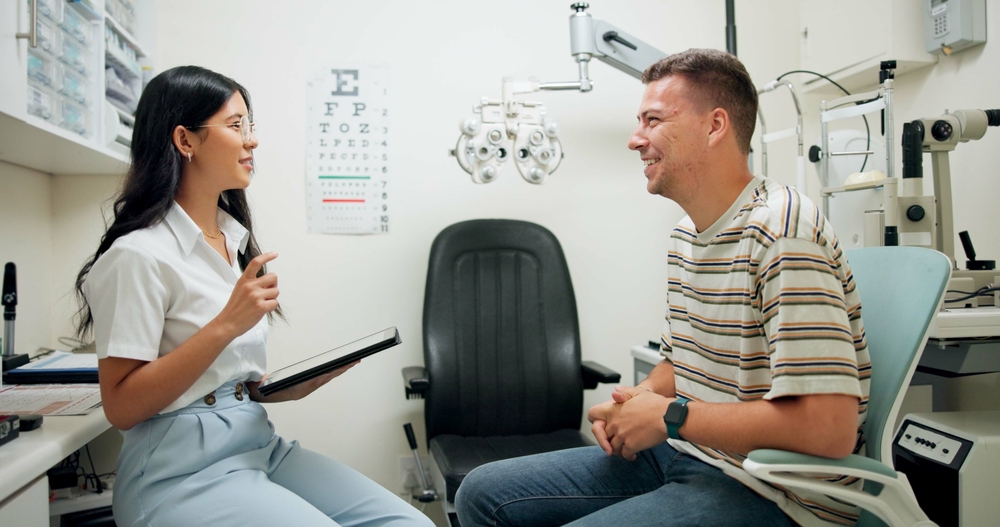
Numbers from a corneal scan only tell part of the story. The rest comes from a conversation about how you actually use your eyes day to day.
Do you drive at night? Stare at a screen for nine hours? Play sports, swim, or work in a dusty environment? Each of those answers shapes how your eye doctor talks about expected results and recovery.
Setting realistic expectations matters here. About 9 out of 10 LASIK patients achieve vision between 20/20 and 20/40 without glasses or contacts. That’s an excellent outcome for most everyday tasks, though a small percentage of patients still rely on glasses for specific situations, such as night driving or fine print.
LASIK is also not a fix for presbyopia, the age-related loss of close-up focus that begins around 40. Some patients address presbyopia with monovision, where one eye is corrected for distance and the other for reading. Monovision works well for some people and not for others, which is why testing it with contact lenses first is often recommended.
Your Next Step Toward Clearer Vision
A LASIK consultation is crucial for information gathering about your chosen vision correction procedure. There’s no commitment to surgery and no pressure to schedule on the same day. The goal is to leave with a clear understanding of your eyes, your candidacy, and your options, so the decision you eventually make is the right one for you.
Are you curious whether laser vision correction could work for your life? Schedule a LASIK consultation today at Campus Eye Group in Hamilton, NJ!
 BACK TO ALL BLOGS